

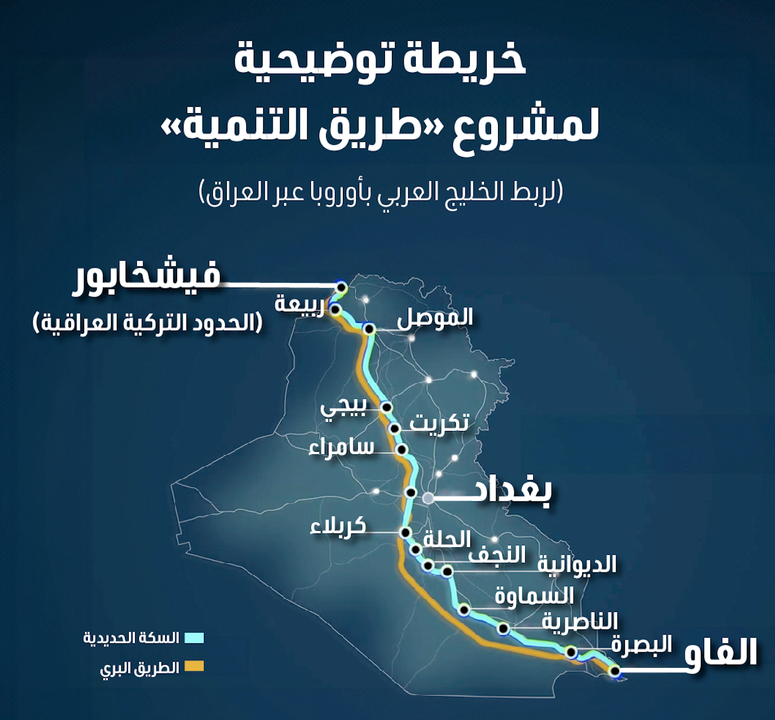
The Iraqi “Development Road” project, which spans 1,200 kilometers, aims to provide over 20,000 job opportunities for citizens in construction, transportation, and industry sectors. It is an important part of the national efforts to combat unemployment and promote economic development in the country.
With a total cost of $17 billion, the project combines a modern railway network and a highway that stretches from southern Iraq to the Turkish border. The “Development Road” is considered one of the largest development projects in the region, contributing to the improvement of infrastructure and enhancing economic activity, according to a report published on (AGBI).
This initiative is part of Iraq’s efforts to boost its economy and modernize its infrastructure, especially with an unemployment rate of approximately 14.4% in 2024. According to the report, Iraq seeks to close the economic gap through large-scale projects that stimulate growth and create job opportunities. The “Development Road” is an important step towards improving the economic situation, as it is expected to have a significant impact on providing job opportunities for Iraqis, particularly among the youth.
It will also contribute to developing workers’ skills and increasing technical training in various fields. These opportunities are expected to positively affect the standard of living for many Iraqi families.
The project includes the construction of a railway line and highway that passes through 11 Iraqi governorates, starting from the Faw Port in southern Iraq to the Turkish border.
The Iraqi Minister of Transport described the project as a “comprehensive economic project,” noting that it is not limited to roads and railways but also includes the construction of large industrial zones along the route. These areas are intended to provide thousands of job opportunities.
The project also includes the development of the largest industrial zone in the Middle East at Faw Port, which will feature residential, commercial, and tourism facilities. The port will be capable of handling 99 million tons of cargo annually, making it one of the top 20 container ports in the world.
It is worth mentioning that five main docks at the port have been completed by the South Korean company Daewoo, and operations are expected to begin in early 2025.
The project is expected to transform Iraq into a vibrant commercial hub linking the Middle East and Europe. While Iraq faces several economic challenges, this project will enhance international trade and open new markets for the country, improving Iraq’s export capabilities and trade balance.
The “Development Road” project aims to reduce travel time between Asia and Europe by linking Basra in Iraq with Ofakoy in Turkey. It is part of the Belt and Road Initiative and the Economic Corridor connecting India, the Middle East, and Europe, as one of the major regional economic integration projects.
Unlike the Belt and Road Initiative and the Economic Corridor, which are international competing projects, the “Development Road” project focuses on Iraq and centers on existing infrastructure projects to transform Iraq into a key trade corridor and infrastructure hub, enhancing its strategic and economic position. This makes the project’s goals and ambitions more realistic.
Additionally, the “Development Road” project can support the Belt and Road Initiative and the Economic Corridor due to Iraq’s geographical location, geopolitical relationships, and continuous infrastructure development. The Faw Grand Port is the key hub in the project, as it will increase Iraq’s capacity to receive large container ships and reduce the country’s reliance on the nearby Umm Qasr port. The Faw Grand Port project was announced in 2010 and work began in 2013. It will serve as the southern terminus of the project, with the first phase expected to be completed by 2028.
The “Development Road,” consisting of a 1,200-kilometer land route and railway line, will connect the Faw Port in Basra to Fish Khabur on the Turkish border, and from there, to the Turkish road and railway network, providing access to the Mediterranean Sea through Mersin Port and Europe via land routes from Istanbul.